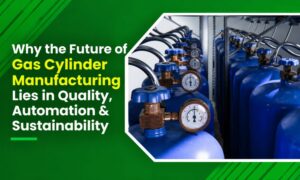
The future of gas cylinder manufacturing is no longer defined simply by how many cylinders a manufacturer can produce. For industries handling compressed gases at high pressure, the real differentiators are material integrity, manufacturing precision, inspection, consistency, automation, and responsible use of resources.
This shift is particularly important for healthcare providers, CNG and alternative-fuel businesses, and commercial users. As applications become more demanding, choosing the right gas cylinder supplier is becoming a decision about long-term safety and reliability not just product availability.
Quality Starts With the Cylinder, Not the Final Inspection
A high-pressure cylinder operates in an environment where manufacturing consistency matters. The quality of the steel or composite material, forming processes, dimensional accuracy, surface condition, heat treatment where applicable, and inspection procedures all contribute to the performance of the finished cylinder.
For medical oxygen applications, dependable cylinders are part of an infrastructure that supports hospitals, healthcare providers, and oxygen distributors. In automotive applications, high-pressure cylinders need to withstand repeated operating conditions associated with CNG and alternative fuels. Commercial users, meanwhile, need dependable cylinders that fit their operational requirements.
This is why experienced gas cylinder suppliers need to demonstrate more than production capability. Buyers should consider the manufacturer’s quality systems, testing practices, applicable standards, traceability, and ability to maintain consistency across production.
Rama Cylinders Private Limited is one of the world’s largest manufacturers of high-pressure seamless steel and composite cylinders. The company complies with major Indian and international quality, safety, and manufacturing standards, including DOT, ISO, and BIS standards.
Why Seamless Manufacturing Matters in High-Pressure Applications
In high-pressure gas storage, the cylinder itself becomes a critical engineered component. Seamless steel construction eliminates a longitudinal welded seam in the cylinder body, making manufacturing control, material properties, forming, and inspection particularly important.
That is one reason buyers should evaluate the manufacturing expertise behind a cylinder rather than treating all gas cylinders as interchangeable products.
The right specification also depends on the application. A cylinder intended for medical gases may have different requirements from one used in CNG systems or other industrial applications. A capable gas cylinder company therefore needs to understand application-specific requirements rather than approaching every order in exactly the same way.
Automation Is Moving Cylinder Manufacturing Toward Greater Precision
Automation is changing the economics and consistency of modern manufacturing. In gas cylinder production, controlled processes can help reduce variation in repetitive operations, improve process repeatability, and support more systematic quality monitoring.
For a manufacturer operating at scale, this matters because quality cannot depend solely on individual manual intervention. The objective is to create controlled and repeatable processes that deliver consistent results from one production cycle to the next.
Automation also has another important role: data and process visibility. As manufacturing becomes more connected, manufacturers can increasingly monitor production parameters, identify deviations, and use process information to strengthen quality management.
For buyers, this translates into a more meaningful question than simply asking whether a supplier has automated equipment: Can the manufacturer consistently control the processes that determine cylinder quality?
Sustainability Is Becoming Part of Manufacturing Performance
Sustainability in cylinder manufacturing is not limited to using less energy. It also involves how effectively a manufacturer uses raw materials, manages manufacturing waste, improves process efficiency, and produces durable products capable of serving demanding applications.
Longer-lasting products can have an important sustainability dimension because manufacturing resources are being used to produce equipment intended for continued service rather than frequent replacement.
As industrial buyers increasingly consider environmental performance alongside cost and quality, sustainable manufacturing is becoming part of the broader definition of a responsible supplier.
What Should Businesses Look for in Gas Cylinder Suppliers?
For businesses evaluating gas cylinder suppliers, the purchasing decision should begin with the application and move toward the manufacturer’s capabilities.
Consider these factors:
- Application suitability: Does the cylinder match the intended gas, pressure, environment, and operating requirements?
- Manufacturing capability: Does the supplier have relevant expertise in seamless steel or composite cylinder production?
- Quality and standards: Can the manufacturer demonstrate compliance with applicable quality and safety requirements?
- Consistency and supply: Can the supplier maintain dependable product quality and supply at the required scale?
This approach is particularly relevant for healthcare organizations, oxygen distributors, CNG and alternative-fuel businesses, and commercial establishments that cannot afford unreliable supply or inconsistent product quality.
Looking for Quality Gas Cylinders? Explore reliable cylinder solutions for your industrial and commercial needs with Rama Cylinders.
Where Rama Cylinders Fits Into the Future
Rama Cylinders Private Limited operates at the intersection of high-pressure cylinder engineering, manufacturing capability, quality requirements, and diverse industrial applications.
Its portfolio of high-pressure seamless steel and composite cylinders serves sectors where dependable gas storage is essential. From healthcare applications requiring medical gas cylinders to automotive and transportation applications involving CNG and alternative fuels, the requirements may differ—but the importance of manufacturing quality remains constant.
For buyers comparing a gas cylinder company, this combination of product expertise and manufacturing capability is increasingly important. The supplier needs to be equipped not only for today’s requirements but also for an industry moving toward greater precision, automation, and resource efficiency.
The Future Belongs to Smarter Gas Cylinder Manufacturing
The next phase of gas cylinder manufacturing will be shaped by a combination of engineering quality, controlled production, automation, safety, and sustainability.
Quality provides the foundation. Automation can improve repeatability and process control. Sustainable manufacturing encourages better use of materials and resources. Together, these factors are changing what buyers should expect from modern gas cylinder manufacturers.
For healthcare providers, CNG and alternative-fuel businesses, and commercial users, the choice of supplier therefore deserves a broader evaluation than price alone.
A dependable gas cylinder supplier should bring together the product, manufacturing expertise, quality systems, and application understanding required for the job. With its focus on high-pressure seamless steel and composite cylinders, Rama Cylinders is positioned to be part of that future.C
Frequently Asked Questions
Q1. What should businesses consider when choosing gas cylinder suppliers?
Answer: Businesses should evaluate application suitability, manufacturing expertise, quality and safety standards, inspection and testing practices, product consistency, supply capability, and technical support. The right supplier should understand the operating requirements of the application rather than simply supplying a standard cylinder.
Q2. Why are seamless steel cylinders used for high-pressure gas applications?
Answer: Seamless steel cylinders are manufactured without a longitudinal welded seam in the cylinder body. Their suitability for high-pressure applications depends on factors including material properties, manufacturing processes, design, testing, and compliance with applicable standards. The specific cylinder must always be selected according to its intended gas and operating requirements.
Q3. How is automation improving gas cylinder manufacturing?
Answer: Automation can improve repeatability, process control, production consistency, and monitoring of manufacturing operations. For large-scale cylinder manufacturers, controlled automated processes can help reduce process variation and support consistent quality across production.
Q4. Why is sustainability important for gas cylinder manufacturers?
Answer: Sustainability encourages manufacturers to improve material utilization, reduce avoidable waste, increase process efficiency, and consider the durability and service life of products. For industrial buyers, responsible manufacturing is increasingly becoming an important part of evaluating long-term suppliers.
Q5. What industries use high-pressure gas cylinders?
Answer: High-pressure gas cylinders are used across several sectors, including healthcare and medical oxygen distribution, CNG and alternative-fuel transportation, industrial gas applications, and commercial establishments. Cylinder specifications vary according to the gas, pressure, application, and applicable regulatory requirements.
Q6. Why is Rama Cylinders relevant to the future of gas cylinder manufacturing?
Answer: Rama Cylinders Private Limited is one of the world’s largest manufacturers of high-pressure seamless steel and composite cylinders. Its manufacturing portfolio serves diverse applications, while its stated compliance with DOT, ISO, and BIS standards reflects the importance placed on recognized quality, safety, and manufacturing requirements.

Amit V. Ramsinghani
Amit V. Ramsinghani serves as the Executive Director of Rama Cylinders, overseeing daily operations since the company's inception in 2005. He holds a Bachelor of Science in Business Administration from Babson College in Boston, USA. Under his leadership, the company has strategically entered new markets, developed superior products, and secured significant global and Indian tenders.