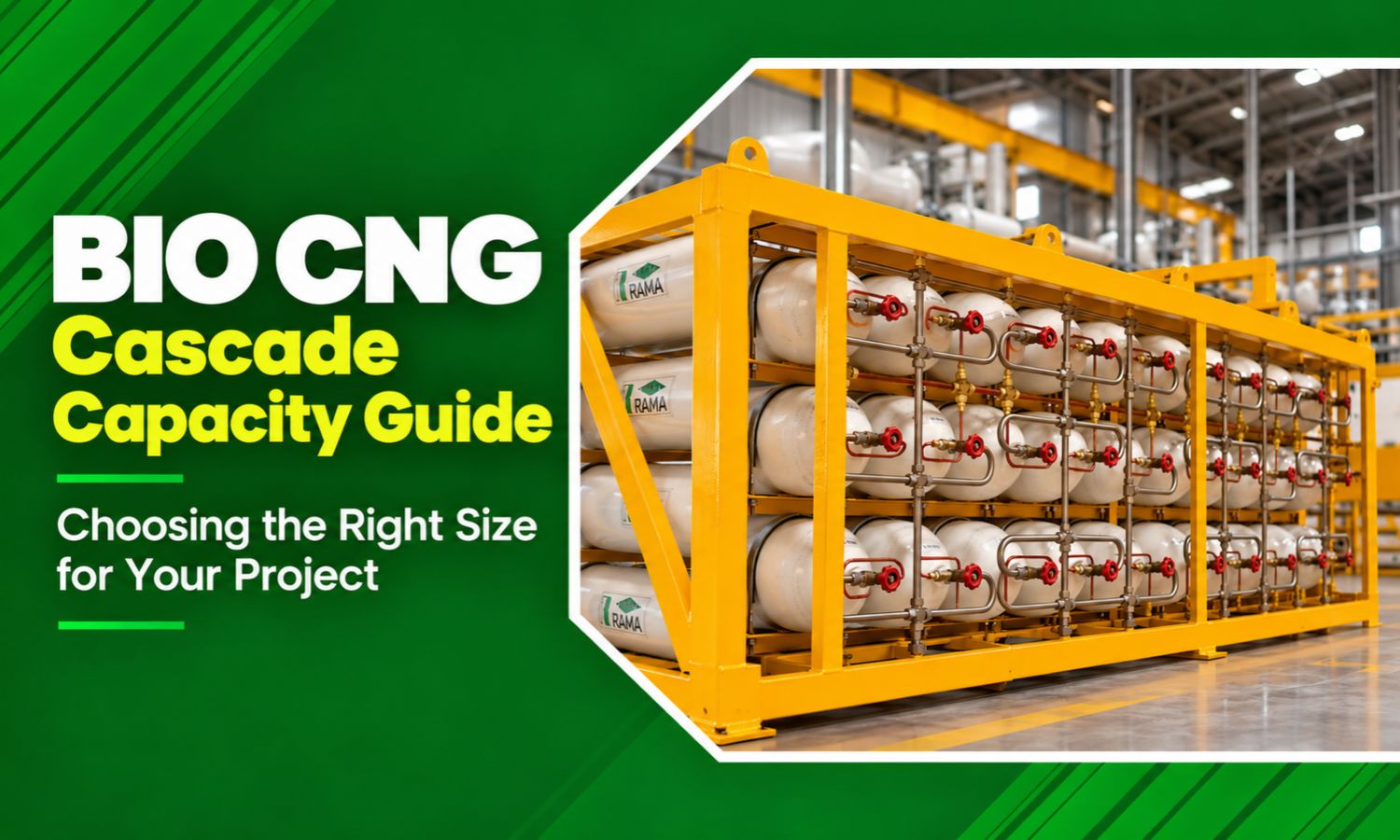
Selecting a BIO CNG Cascade is not simply a matter of choosing the highest available storage capacity. For a Bio-CNG or CBG project, the cascade configuration needs to correspond with gas demand, storage requirements, cylinder configuration, operating pressure, filling cycles, and the physical constraints of the installation site.
A correctly selected cascade can provide the required high-pressure gas storage without unnecessarily increasing the equipment footprint, handling requirements or overall system weight. This makes capacity selection an important consideration during project planning and procurement.
What Is a BIO CNG Cascade?
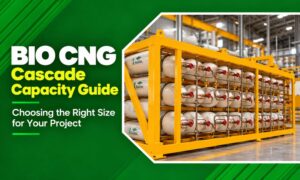
A BIO CNG Cascade consists of multiple high-pressure gas cylinders assembled into a common storage arrangement. The cylinders are interconnected so that compressed gas can be stored and supplied according to the requirements of the installation.
For Bio-CNG applications, cascade capacity is generally discussed in terms of the combined nominal water capacity of the cylinders, expressed in litres. This should not be confused with the actual or approximate volume of compressed gas.
For example, the Rama Cylinders specification indicates an approximate gas capacity of 23.5 m³ for a 75-litre cylinder. The distinction between water capacity and gas capacity is important when comparing different cascade configurations.
How Do You Select the Right BIO CNG Cascade Capacity?
The appropriate configuration should be evaluated against the project’s operating profile rather than capacity in isolation.
- Establish the gas requirement: Determine the expected gas consumption, operating schedule and required storage availability for the application.
- Assess the required storage capacity: Compare the required storage with available cylinder sizes and cascade configurations.
- Review filling and operating cycles: The frequency at which the cascade is replenished can influence the amount of storage required at the site.
- Evaluate site constraints: Cascade dimensions, weight, installation area, access, transportation and handling requirements should be considered before final selection.
The final configuration should be established according to the project’s engineering requirements and applicable technical and safety considerations.
BIO CNG Cascade Capacity Options from Rama Cylinders
Rama Cylinders’ supplied specifications show fabricated CNG cascade configurations using 267 mm diameter, 75-litre water-capacity cylinders, with cylinder length specified as 1710 mm.
The listed cascade capacities range from 900 litres to 4,500 litres, providing different configurations for varying storage requirements.
| Cascade Capacity | Cylinders | Dimensions L × W × H | Approx. Weight |
| 900 L | 12 | 1615 × 1850 × 1135 mm | 2.0 ton |
| 1200 L | 16 | 1615 × 1850 × 1450 mm | 2.3 ton |
| 1500 L | 20 | 1985 × 1850 × 1450 mm | 2.9 ton |
| 2025 L | 27 | 2595 × 1850 × 1450 mm | 4.1 ton |
| 2250 L | 30 | 2900 × 1850 × 1450 mm | 4.4 ton |
| 3000 L | 40 | 3515 × 1850 × 1450 mm | 5.8 ton |
| 4500 L | 60 | 5085 × 1850 × 1565 mm | 8.5 ton |
The specifications also include 150-litre-cylinder cascade configurations at 3,000 litres, 4,500 litres and 5,400 litres. This provides another configuration pathway where the project’s storage and installation requirements call for larger individual cylinders.
The listed working pressure is 260 kgf/cm² (255 bar) for domestic applications and 25 MPa (250 bar) for export applications, according to the supplied product specification.
What Should You Evaluate Before Ordering a BIO CNG Cascade?
A project specification should go beyond the headline capacity. The cylinder water capacity, approximate gas capacity, number of cylinders, working pressure, overall dimensions and cascade weight all have practical implications for installation and operation.
Site accessibility also deserves attention. A cascade with a greater storage capacity can have a different dimensional and weight profile, affecting transportation, positioning, lifting and available installation space.
For procurement teams, it is therefore useful to provide the manufacturer with the project’s expected gas requirement, operating conditions, installation constraints and intended application before finalizing the configuration.
Why Choose Rama Cylinders for BIO CNG Cascade Requirements?
Rama Cylinders manufactures high-pressure seamless gas cylinders and Type 1 CNG & Bio Gas Cascades for compressed gas storage applications. Its fabricated cascade range includes multiple cylinder configurations and storage capacities, allowing project requirements to be evaluated against the available product configurations.
Rather than selecting a cascade solely by its litre rating, project teams can discuss the intended application, storage requirement and physical installation conditions with Rama Cylinders before finalizing the specification.
If you are developing a Bio-CNG plant, CBG project, gas storage facility or related compressed gas application, the right cascade configuration should be established early in the project planning process.
Looking for safe, tested, and regulation-compliant gas cylinders? Get in touch with Rama Cylinders and secure your operations today.
Frequently Asked Questions
Q1. What is a BIO CNG Cascade?
Answer: A BIO CNG Cascade is an interconnected assembly of high-pressure cylinders designed for compressed gas storage and supply. It can be configured with multiple cylinders to achieve the storage requirement of a particular Bio-CNG or CBG application.
Q2. How is BIO CNG Cascade capacity measured?
Answer: Cascade capacity is commonly expressed through the combined nominal water capacity of the cylinders in litres. This is different from approximate gas capacity, which is expressed in cubic metres and depends on the relevant operating conditions.
Q3. Which BIO CNG Cascade size is suitable for my project?
Answer: The appropriate configuration depends on the project’s gas requirement, storage objective, operating cycle, cylinder configuration, site dimensions and handling conditions. A project-specific assessment is preferable to selecting a cascade based only on its nominal capacity.
Q4. Does Rama Cylinders manufacture CNG and Bio Gas Cascades?
Answer: Yes. Rama Cylinders manufactures Type 1 CNG & Bio Gas Cascades and provides fabricated cascade configurations in multiple storage capacities and cylinder arrangements.

Amit V. Ramsinghani
Amit V. Ramsinghani serves as the Executive Director of Rama Cylinders, overseeing daily operations since the company's inception in 2005. He holds a Bachelor of Science in Business Administration from Babson College in Boston, USA. Under his leadership, the company has strategically entered new markets, developed superior products, and secured significant global and Indian tenders.