For an international buyer, sourcing CNG cylinders from India involves more than finding a manufacturer that can ship overseas. The cylinder specification, manufacturing process, inspection, testing, traceability, and documentation all need to match the requirements of the intended application and destination market.
This is particularly important when purchasing Type 1 CNG cylinders in bulk, where consistency across the entire order becomes a key procurement consideration.
What Does an Export-Ready Type 1 CNG Cylinder Need?
An export-ready Type 1 CNG cylinder should satisfy the technical, quality and documentation requirements applicable to its intended use and destination.
A buyer should look at five areas:
- Suitable cylinder design and material
- Controlled and consistent manufacturing
- Required inspection and testing
- Product identification and traceability
- Applicable compliance and export documentation
In other words, “export-ready” does not simply mean that cylinders can be transported to another country. The product and its supporting records should be prepared according to the requirements of the specific order and market.
Why Type 1 Cylinder Construction Matters for Export Buyers
Type 1 CNG cylinders are all-metal cylinders, generally based on a seamless steel cylinder body designed for high-pressure gas storage.
For buyers, the construction itself is only one part of the evaluation. Material quality, manufacturing consistency, dimensional accuracy, surface condition and inspection all contribute to whether cylinders meet the agreed specification.
This becomes even more important for an international Type 1 CNG cylinder supplier handling bulk orders.
When hundreds or thousands of cylinders are purchased, buyers need consistent specifications from one cylinder to the next, not just a satisfactory sample.
Testing and Quality Control: What Should Buyers Verify?
Pressure vessels require appropriate inspection and testing because product failure can have serious safety and operational consequences.
Depending on the applicable standard and customer requirements, buyers may need to verify:
- Material verification
- Dimensional inspection
- Visual examination
- Pressure testing
- Leak testing, where applicable
- Mechanical or material-property verification
- Batch inspection and quality records
- Final inspection before dispatch
The exact testing requirements should be established against the applicable cylinder standard, gas service, customer specification, and destination-market requirements.
For an export buyer, documented inspection results are important because they provide evidence that the cylinders have undergone the required quality checks.
Looking for Type 1 CNG & biogas cascades?
Explore Rama Cylinders’ product specifications and discuss your storage requirements with the team.
View CNG & Bio Gas Cascade →
Compliance and Documentation Can Decide Whether an Export Works
CNG cylinder requirements are not identical in every market. The applicable requirements can depend on the destination country, cylinder standard, gas application, transport regulations, customer specifications, and import requirements.
Before placing an export order, buyers should clarify the documentation required for the shipment.
This may include:
- Test certificates
- Inspection records
- Material certificates, where applicable
- Product identification and traceability records
- Packing and shipping documentation
- Applicable compliance or certification documents
Clarifying these requirements before production and dispatch can help avoid documentation-related issues later in the export process.
Why Manufacturing Consistency Matters in Bulk CNG Cylinder Exports
An international buyer is usually evaluating much more than one cylinder.
The bigger question is whether the Type 1 CNG cylinder manufacturer can maintain the agreed specification throughout a complete production batch and across future orders.
Important factors include:
- Consistent manufacturing parameters
- Repeatable dimensions and specifications
- Batch traceability
- Production capacity
- Quality control throughout manufacturing
- Reliable delivery planning
- Ability to support repeat or bulk requirements
For long-term procurement, the first shipment is only one part of the relationship. Consistency across subsequent orders is equally important.
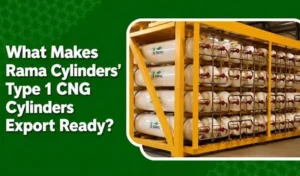
How Do CNG Cascades Change the Cylinder-Sourcing Requirement?
A CNG cascade uses multiple high-pressure cylinders connected through a common manifold or storage arrangement.
Because several cylinders form part of the same system, consistency becomes particularly important. Buyers need to consider cylinder specifications, pressure ratings, dimensions, testing requirements and documentation as part of the overall storage arrangement.
This makes the selection of both the cylinders and the manufacturer important when planning a CNG cascade project.
What Should You Look for in CNG Cascade Manufacturers in India?
When comparing CNG cascade manufacturers in India, price should not be the only consideration.
An international procurement team should evaluate:
- Cylinder manufacturing capability
- Applicable standards and certifications
- Inspection and testing processes
- Product and batch traceability
- Bulk production capability
- Technical documentation
- Export support
- Project-specific requirements
- Consistency across production batches
A supplier that can clearly address these areas provides a stronger basis for evaluating an international CNG cylinder order.
Why Consider Rama Cylinders for Your International CNG Cylinder Requirement?
Rama Cylinders manufactures high-pressure seamless steel gas cylinders and offers Type 1 CNG & biogas cascades for gas storage requirements.
For an international requirement, buyers can discuss their specific product and project details with Rama Cylinders, including:
- Required cylinder capacity
- Working pressure
- Quantity
- Destination country
- Applicable standard or certification requirement
- Delivery requirements
- CNG cascade configuration
This approach allows the requirement to be evaluated according to the customer’s actual application and export-market needs rather than relying on a generic product description.
Planning a Type 1 CNG Cylinder Export Order from India?
Share your required capacity, working pressure, quantity, destination country, applicable standard, and delivery requirement with Rama Cylinders.
Enquire Now →
Ready to Source Type 1 CNG Cylinders from India?
For an international buyer, Type 1 CNG cylinder export readiness depends on more than manufacturing the cylinder and arranging shipment.
Product specifications, manufacturing consistency, inspection, testing, traceability and documentation all need to be considered against the requirements of the intended market and application.
For bulk CNG storage or cascade projects, consistency becomes even more important because multiple cylinders operate as part of the same storage arrangement.
If you are evaluating a Type 1 CNG cylinder manufacturer or CNG cascade supplier in India, start by clearly defining your technical specifications, destination-country requirements, and documentation needs before placing the order.
Frequently Asked Questions
Q1. What is a Type 1 CNG cylinder?
Answer: A Type 1 CNG cylinder is an all-metal, seamless steel cylinder designed for high-pressure compressed natural gas storage, subject to the applicable design and manufacturing requirements.
Q2. What makes a Type 1 CNG cylinder export ready?
Answer: An export-ready cylinder should meet the applicable product and destination-market requirements for design, manufacturing, testing, inspection, traceability and documentation.
Q3. What is a CNG cascade?
Answer: A CNG cascade is a storage arrangement consisting of multiple high-pressure cylinders connected through a common manifold or system for CNG storage.
Q4. How do I choose CNG cascade manufacturers in India?
Answer: Compare manufacturers based on manufacturing capability, applicable standards, testing, traceability, documentation, production capacity and consistency across bulk orders.

Amit V. Ramsinghani
Amit V. Ramsinghani serves as the Executive Director of Rama Cylinders, overseeing daily operations since the company's inception in 2005. He holds a Bachelor of Science in Business Administration from Babson College in Boston, USA. Under his leadership, the company has strategically entered new markets, developed superior products, and secured significant global and Indian tenders.